
Dispute Resolution
The Condominium Authority Tribunal Process
The Condominium Authority Tribunal follows a three-stage process designed to help parties resolve issues as quickly and affordably as possible.
What to expect
Our Tribunal cases take place fully online through our dispute resolution platform. Parties can file an application and participate in the case asynchronously by writing to each other in the platform while following Tribunal deadlines.
Here is an overview of the process:
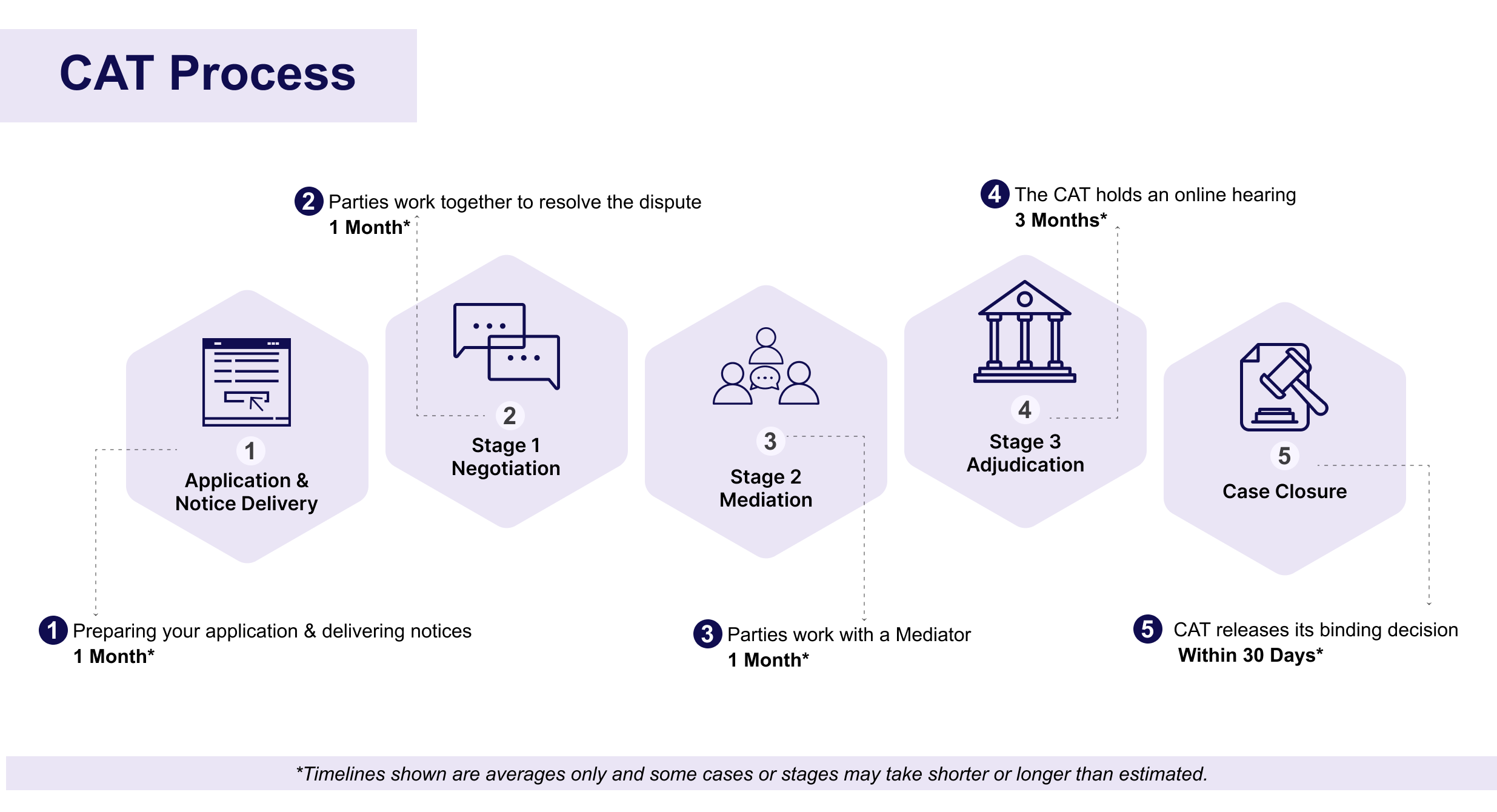
Parties work through a three-stage process:
- Stage 1: Negotiation – Work together to try to resolve the dispute.
- Stage 2: Mediation – A neutral mediator helps you explore possible solutions.
- Stage 3: Adjudication – A Tribunal Member reviews the evidence and issues a final, binding decision.
How much will I have to pay?
| Step | Fee |
|---|---|
| Filing an application | $25 |
| Move to Stage 2: Mediation | $50 |
| Move to Stage 3: Adjudication | $125 |
A case that proceeds through all three stages costs $200 in Tribunal fees.
Additional costs may be awarded by the Tribunal in certain circumstances. See the Practice Direction on Approach to Ordering Costs for more information.
Before you start
Make sure the Tribunal has the jurisdiction to hear your issue.
Having the following information ready will help you complete your application more quickly:
- Names of all parties involved
- Email addresses for other parties, if available
- Documents or evidence related to the dispute
- Your condo corporation’s governing documents
- A summary of what happened
- Information about the outcome you are seeking
Filing an application
The Tribunal process begins when an application is submitted through the CAT’s online system.
You will be asked to:
- Sign in or create an account
- Select the dispute type
- Identify the parties involved
- Describe the issue
- Upload supporting documents, if applicable
Who can file?
| Applicant | Can file against |
|---|---|
| Unit Owner | • Other owners • Their condo corporation • Tenants |
| Condo Corporation | • Their unit owners • Tenants |
Please note:
- Condo corporations must be added as parties in every case, even when the dispute is between unit owners.
- Any co-owners of a unit should be included in the case.
- Landlords must participate in cases involving their tenants.
- Tenants cannot file applications directly and must work through their landlords.
Notifying other parties
You must notify other parties about your case once your application is accepted if they don’t respond to the CAT’s automated email notice, or if you did not provide an email for them.
Make sure to log in and follow the instructions and timelines set out in the system.
Here’s how you notify other parties:




Log in and confirm how you delivered the notice once you’ve done so.
Other parties have seven days to join the case if you delivered notices to them in person or twelve if you delivered them by regular mail.
The case will move forward, and decisions will be made, even if they refuse to join after proper notification.
Stage 1: Negotiation
Negotiation is often the fastest and most cost-effective way to resolve a dispute.
Parties communicate directly through the Tribunal system to try to resolve the dispute during this stage. The Tribunal does not participate in negotiations or discussions.
You may:
- Exchange messages with other parties
- Upload documents and evidence
- Ask questions and clarify issues
- Make settlement offers
Negotiation can result in a settlement agreement, which is an agreement the parties come to on their own. Review any offer carefully before accepting it. If all parties agree on a resolution, the system automatically generates a settlement agreement and the case is closed.
Cases close automatically after 30 days of no activity in the CAT system, such as sending a message, uploading a document or creating or responding to a settlement offer. The Tribunal may also close a case if it remains in Stage 1 for more than six months.
Applicants may move the case to Stage 2 by paying a $50 non-refundable fee if the dispute is not resolved or the parties are unable to reach an agreement. If there are multiple applicants, all applicants must agree to proceed.
Stage 2: Mediation
A mediator helps parties communicate, clarify issues and explore options for resolving the dispute. The mediator does not make decisions or take sides.
Mediation may result in:
- A settlement agreement – a private agreement that the parties come to on their own. Parties can enforce these by filing another CAT case later
- A consent order – the parties agree and ask the Tribunal to make their agreement public. Parties can enforce these by going directly to the courts
To move to Stage 3:
- The mediator must grant permission
- The Primary Applicant must pay a $125 non-refundable fee within 15 days after the mediator grants permission to move forward
Stage 3: Adjudication
A Tribunal Member reviews the evidence and submissions provided by all parties and makes a final, binding decision if the dispute is not resolved through negotiation or mediation.
Depending on the circumstances of the case, parties may:
- Submit evidence and supporting documents
- Provide written arguments
- Identify witnesses who may have relevant information
The Tribunal Member will provide instructions throughout the process and establish any required deadlines. Once the hearing process is complete, the Tribunal Member will generally issue a decision within 30 days.
Stage 3 can end through a settlement agreement, consent order, or Tribunal decision, where a Tribunal member decides the case and issues a public binding decision.
After your case - enforcement and next steps
What happens after your case depends on how the case ended.
Settlement Agreement
You may file a new case with the Tribunal seeking an order requiring the other party to comply. Applications must generally be filed within six months of the non-compliance.
Consent order or Tribunal decision
You may seek enforcement through:
- Small Claims Court for monetary orders up to $50,000
- Superior Court of Justice for other matters
Dismissal
You may be able to refile if your case was dismissed due to a missed deadline. You should seek legal advice if the case was dismissed for jurisdictional or other reasons.
Withdrawal
You may be able to refile if you withdrew your application, provided the Tribunal did not issue a decision on the issues raised.
Appeals and judicial review
You may appeal the decision to the Divisional Court if you believe there was an error in how the law was applied.
Appeals:
- Must be based on a question of law – which relates to how the law was interpreted or applied in a decision. It does not include disagreements about the facts, the evidence or the outcome of the case.
- Must be filed within 30 days of the decision
An appeal is not an opportunity to re-argue your case.
In some situations, you may also consider applying for a judicial review if you believe there were issues with how your case was handled. You may wish to seek legal advice before taking this step.
Frequently asked questions
There is a $25 non-refundable filing fee, which also covers the CAT’s costs in reviewing the application.
Additional fees apply if the case moves to later stages.
No. Many cases are resolved during negotiation or mediation.
The Tribunal may continue with the case and make decisions without that party participating.
Yes. Parties may continue discussing settlement options throughout the process.
Yes, you may have a lawyer, paralegal, or another authorized representative, such as a friend or a family member. Condo corporations must have a representative.
Yes, but only on a question of law and within 30 days of the decision. Appeals must be filed with the Divisional Court.