
Mediation and Arbitration
Mandatory Mediation and Arbitration
Some condo disputes must be resolved through mandatory mediation and arbitration instead of the Condominium Authority Tribunal or the courts.
Broadly speaking, these include disputes about:
- Shared facilities agreements
- First-year budgets
- Governing documents issues outside the CAT’s jurisdiction
- Changes to common elements by owners
- Electric vehicle charging system installations.
- And more
Condo by-laws may establish procedures for mediation and arbitration, which may vary from condo to condo.
What is the difference between mediation and arbitration?

Mediation is a collaborative and confidential process led by a neutral, third-party mediator who helps the parties work together to try to find a solution that works for everyone. Mediation can preserve relationships and help avoid lengthy and costly legal proceedings.

Arbitration is also confidential and led by a neutral third-party, but the arbitrator has a mandate to make a binding decision about the dispute. The arbitrator guides the process for how parties should present their case through a process that is less formal than the courts. The aim is to still find a resolution even if the parties can’t agree.
What disputes must go to mediation and arbitration?




What is the mandatory mediation and arbitration process?
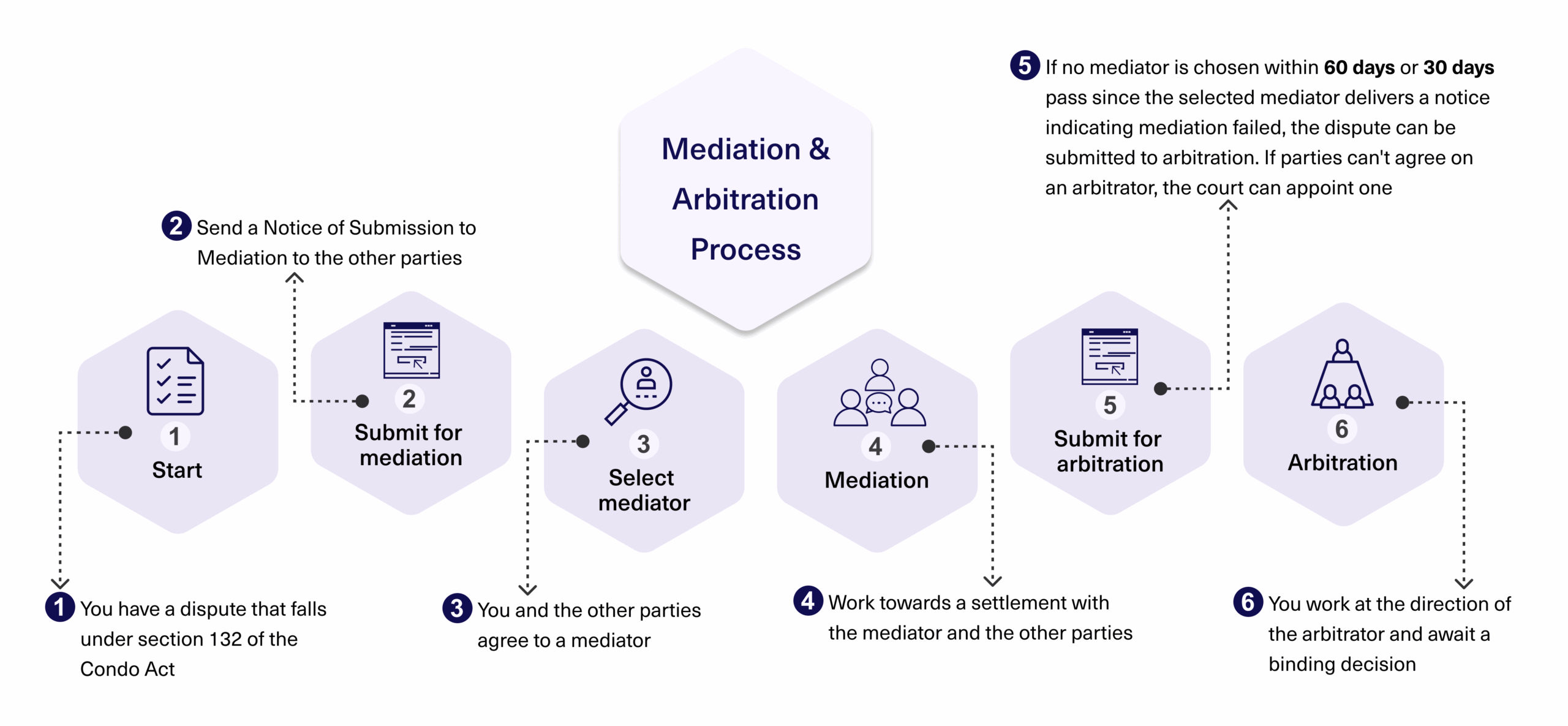
How mandatory mediation works step-by-step
Find a mediator while staying consistent with your condo's by-laws.
Mediators are not regulated and don’t require a licence to practise anywhere in Canada, but the ADR Institute of Canada sets informal standards, offers professional designations and provides contacts of individuals that can help guide those looking for mediation and arbitration services. Whomever you choose, make sure to speak with them directly to ensure they are available and have expertise in your issue.
Some condos have mediation by-laws that set mediator criteria and mediation procedures. These may include impartiality, not having conflicts of interest, as well as having experience and education requirements.
Keep in mind you or the other party can propose mediators, but all parties must agree on a chosen individual collectively.
Here are some questions to consider when looking for a mediator:
1. Does the mediator have relevant qualifications?
2. Do they adhere to a code of ethics?
3. Does the mediator have experience in the condo sector?
4. When did they complete the CAO’s Director Training?
5. Is the mediator’s style the right fit for me to comfortably and fully participate?
6. How do they approach the confidential nature of the mediation process?
7. Does this fit my budget? What is the mediator’s fee structure? Will they require a retainer in advance of mediation and am I willing to pay it?
8. Is the mediator’s availability compatible with my schedule and timeline?
9. Does the mediator allow for participation methods, such as online and in-person sessions, that suit me? If the mediation will take place in-person, it can be important to consider where, as that may increase costs.
10. Is the mediator impartial? Have they worked with others involved in my dispute before?
11. Does the mediator have professional liability insurance to cover negligent acts, errors or omissions in the mediation process?
A common misconception involved in mediator selection involves focusing on a mediator’s settlement rate. A mediator can’t guarantee a settlement. It is best to focus on the recommended questions above instead.
Submit your dispute for mediation
Once you have identified the mediators you want, you can use our Notice of Submission to Mediation template to submit your intention to mediate along with your list of preferred mediators to the other party.
The other party can then respond using our Response to Notice of Submission to Mediation template.
If the parties can’t agree on a mediator during this exchange within 60 days, the dispute can move to arbitration.
If the parties agree, the mediator will begin scheduling the mediation.
During mandatory mediation
Your mediator will guide the process while impartially communicating with both parties and assisting in working towards a resolution. You should expect your mediator to create a safe space for dialogue. You should also expect that all discussions will remain confidential, including the terms of the settlement agreement unless otherwise specified.
In mediation, you control the outcome, and your mediator helps along the way. The only requirement in this regard for the mediator found in the Condo Act is that they make a written record of the outcome of mediation which can be done using our Mediation Report template.
Finding a mediator
Don’t know where to start looking? Visit our page on finding a mediator
Find a mediator
How mandatory arbitration works step-by-step
Finish mediation and prepare for arbitration
You can generally move your issue to arbitration 30 days after the mediator delivers a notice back to you and the other party indicating that mediation did not resolve the dispute.
Alternatively, you can also move to arbitration 60 days after you submitted the issue for mediation and you and the other parties were unable to agree on a mediator during that time.
Choose an arbitrator
Parties should attempt to agree on a chosen arbitrator. That individual then gains the authority to make a binding decision about their issue.
If there is no agreement on an arbitrator, an application can be made to the Superior Court of Justice to appoint one – adding cost and delay.
Condo by-laws can set out criteria or a procedure for arbitrator selection, which must be followed.
Whether you are following your by-laws, assessing the other party’s nomination, or looking for your own arbitrator, it may be helpful to consider the following questions:
1. Does the arbitrator have relevant qualifications?
2. Do they adhere to a code of ethics?
3. Does the arbitrator have experience with similar cases?
4. When did they complete CAO’s Director Training?
5. Does their style and process facilitate comfortable participation for me?
6. What will confidentiality mean in my arbitration?
7. How much will this arbitrator cost? Do they have cancellation fees or a retainer fee?
8. Will they be available at the right time to help resolve my issue?
9. Does the arbitrator allow for diverse participation methods that suit me, be it documents-only, online, hybrid, or in-person? Are there extra costs tied to doing the arbitration in-person?
10. Is the arbitrator impartial? Have they worked with others involved in this dispute before?
11. Does the arbitrator have professional liability insurance to cover negligent acts, errors or omissions in the arbitration process?
12. How long will the arbitrator take to provide their decision?
During arbitration
The arbitrator appointed to your dispute is responsible for making sure the process is fair and impartial. They will ensure all parties have an equal opportunity to present their case, consider evidence, and issuing a binding decision. Unlike mediation, where the mediator may have private communications with only some of the parties, the arbitrator will communicate with all parties at the same time.
After arbitration
Arbitration is intended to end the dispute. Successful appeals of an arbitrator’s decision are typically limited and rare as the courts will typically defer back to the arbitrator.
If a party does not comply with the award, other parties can go to court for an order to enforce it. Having to do so risks compromising some of the confidential aspects of arbitration.
Finding an arbitrator
Don’t know where to start looking? Visit our page on finding an arbitrator
Find an arbitrator
Mediation and Arbitration Case Studies
Explore some case studies to better understand how mediation and arbitration can resolve condo disputes.
Dale, a condo owner, was planning to buy an electric vehicle. They wanted to first make sure they could install an electric vehicle charging system in their parking spot.
After looking into it, Dale realized it was best to get approval from their condo for the charging station they wanted to install in their parking spot. Dale put together an application to install an electric vehicle charging system and emailed it to their condo manager.
Months pass with no reply, so Dale decides to submit the matter to mediation. Dale reviewed their condo’s governing documents and could not find a mediation-arbitration by-law.
Dale used the CAO’s Notice of Submission to Mediation template to propose online mediation with their condo, suggesting three mediators who Dale was comfortable with. The condo’s lawyer replied agreeing to one of the mediators Dale suggested. The parties were guided forward with the help of the mediator and were able to reach a settlement of the matter. Dale was able to proceed with their electric vehicle purchase with the comfort that suitable charging station arrangements had been made with their condo.
Jordan was a condo owner with a green thumb. They wanted to install permanent garden planters on their balcony. After reviewing the condo’s governing documents, Jordan realized that their balcony was an exclusive use common element and that the condo would need to approve the installation. The Board approved the installation and Jordan entered into an alterations agreement with their condo that was registered on title to Jordan’s unit.
With the agreement registered, Jordan went ahead with the installation and enjoyed the extra plants on their balcony. Unfortunately, some neighbours did not, and the condo received complaints about water runoff and damage to balconies below. In response, the board sent Jordan a letter revoking approval of the installation of the planters.
Jordan did not think the board was right to change their mind and learned that disputes about alterations agreement are required by law to go to mandatory mediation and arbitration. The condominium’s by-laws said that parties must first try to negotiate a dispute before moving ahead to mediation.
Jordan and the Board tried to address the issue themselves, but they could not. The condominium then submitted the dispute to mediation. Jordan was not sure about the mediators the condo proposed. After finding a mediator they could afford and were comfortable with, Jordan replied to their condo agreeing to mediate and proposed their preferred mediator, and the condo agreed.
Despite a good faith effort to mediate the matter, Jordan and their condo were unable to find a mutually agreeable resolution. The mediator provided a report confirming that mediation failed and Jordan and their condo moved ahead to arbitration. They agreed on an arbitrator and followed the arbitrator’s guidance to make their submissions and offer their evidence to support the outcome each desired. The arbitrator rendered an award to decide the matter